
Lufthansa Technik tests next-generation AeroSHARK
Lufthansa Technik and partner Surventis are testing a next-generation material for wings and tail surfaces in flight operation
Testing of approximately 70 film patches on a Lufthansa City Airlines Airbus A319 operating between Munich and Hamburg through February 2027
A total of 22 long-haul aircraft from four Lufthansa Group airlines are already equipped with the fuel-saving AeroSHARK surface technology
Reduction in fuel consumption and CO₂ emissions by approximately 1 percent
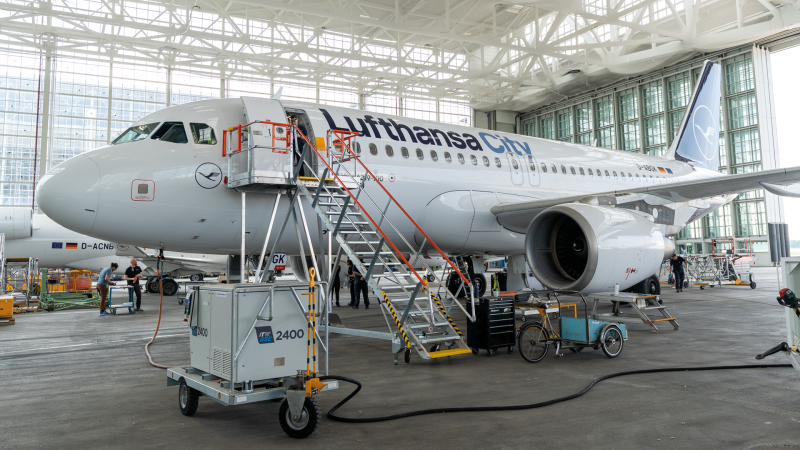
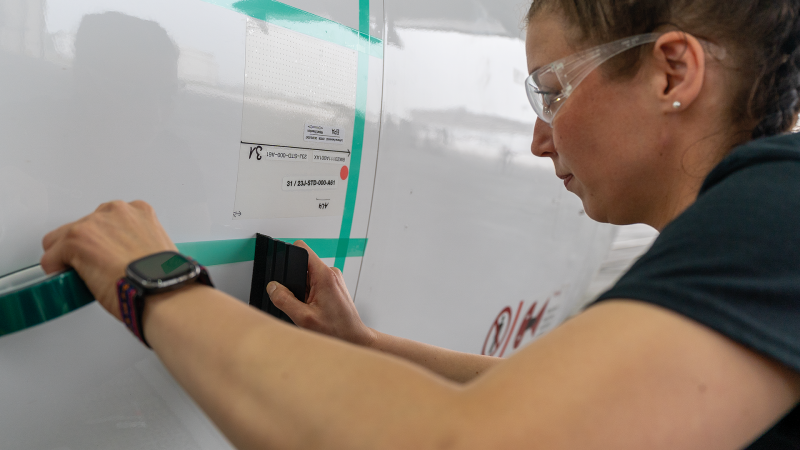
An Airbus A319 of Lufthansa City Airlines will become the world’s first test aircraft for a new generation of fuel-efficient AeroSHARK technology. On the short-haul aircraft with the registration number “D-ABGK,” Lufthansa Technik, in collaboration with its development partner Surventis (formerly BASF Coatings), will test approximately 70 transparent film patches, each measuring 20 x 20 centimeters, through February 2027. These material samples are attached to selected areas on the sides of the fuselage as well as on the inside and outside of the engine cowlings. Their performance will be analyzed over the next few months during regular flight operations between Munich and Hamburg and is expected to provide insights for the further development of the AeroSHARK technology. The long-term goal is to tap into additional efficiency potential in flight operations through the broader use of AeroSHARK, thereby contributing to greater sustainability in air travel.
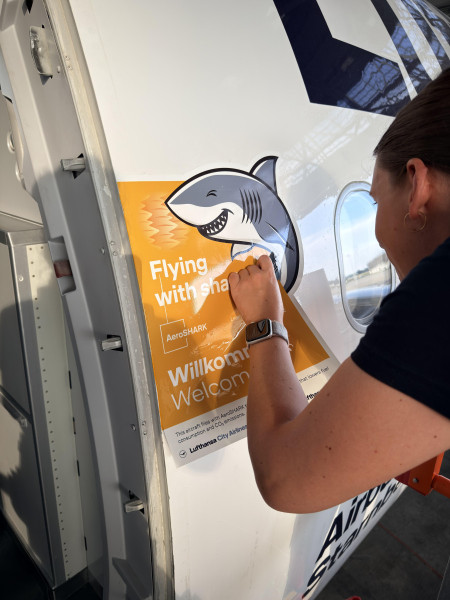
For passengers aboard the Lufthansa City Airlines aircraft bearing the name of the city “Starnberg,” the test remains virtually invisible. The material is transparent and hardly noticeable to the eye. Flight operations also remain unchanged. For informational purposes, a welcome panel featuring the AeroSHARK design at the aircraft’s entrance draws the attention of interested travelers to the test.
The patch test: Research meets real-world flight operations
To date, the fuel-saving AeroSHARK film has been used on the fuselage and engine cowlings of long-haul aircraft certified for this technology. With their current research and development work, Lufthansa Technik and Surventis are now taking an important step forward. Together, they are developing the next-generation material, which could also be used on wings as well as horizontal and vertical stabilizers in the future. These areas are exposed to higher aerodynamic loads.
With the test run that has now begun, various new AeroSHARK material samples are being evaluated under real-world conditions. The 70 test patches differ in terms of their material and layer composition. The goal of the study is to identify the material that combines the highest durability with easy application, straightforward cleaning, and residue-free removal. Lufthansa Technik conducts regular material inspections during regular ground time in Hamburg.
Inspired by nature
To date, AeroSHARK is the only riblet technology approved for commercial aviation. It consists of a specially developed surface film with microscopically fine grooved structures modeled after shark skin. The skin of sharks features fine grooves aligned with the direction of flow - known as riblets - which reduce frictional drag and improve flow characteristics in water. AeroSHARK applies this effect to aviation: The functional surface film features riblets only about 50 micrometers high, precisely aligned with the airflow. It is applied to an aircraft’s fuselage and engine cowlings and reduces aerodynamic drag during flight. The technology reduces fuel consumption and CO₂ emissions on every flight—currently by about 1 percent.
22 Lufthansa Group long-haul aircraft have already been equipped with AeroSHARK
As of July 2026, the Lufthansa Group has already equipped 22 aircraft with AeroSHARK: SWISS’s entire fleet of Boeing 777-300ERs (twelve aircraft), five Boeing 777Fs from Lufthansa Cargo, four Boeing 777-200ERs from Austrian Airlines, and one Boeing 747-400 from Lufthansa. As a result, the Lufthansa Group’s AeroSHARK fleet saves 19 metric tonnes of fuel and 60 metric tonnes of CO₂ daily. AeroSHARK is also gaining traction across the industry: Airlines outside the Lufthansa Group are also already using this innovative film to increase the fuel efficiency of their long-haul aircraft.
About Lufthansa Technik:
The Lufthansa Technik Group is one of the leading providers of technical aircraft services in the world. Certified internationally as a maintenance, production and design organization, the company employs around 23,000 people in locations around the globe. Lufthansa Technik offers the full range of services for commercial, VIP and special mission aircraft. The portfolio includes maintenance, repair, overhaul and modification of airframes, engines, components and landing gears, as well as the manufacture of innovative cabin products and digital fleet support.
About Surventis (formerly BASF Coatings):
For more than 130 years, Surventis has combined science and passion to prepare, protect, and seal metal and plastic surfaces across a wide range of industries, to paint new vehicles in vibrant colors, and to repair them with precise color matching. Through brands such as Chemetall®, Glasurit®, and R-M®, Surventis works side by side with more than 42,000 customers in over 140 countries to develop solutions for their most complex surface-related challenges. The company employs approximately 10,700 people, generated revenue of around 3.9 billion euros in 2025, and is headquartered in Münster, Germany. Surventis is owned by funds managed by Carlyle; BASF continues to hold a 40 percent stake.